Words
Rabbi Yosef Mizrachi’s own voice carries the teaching, as he delivered it across decades of shiurim.
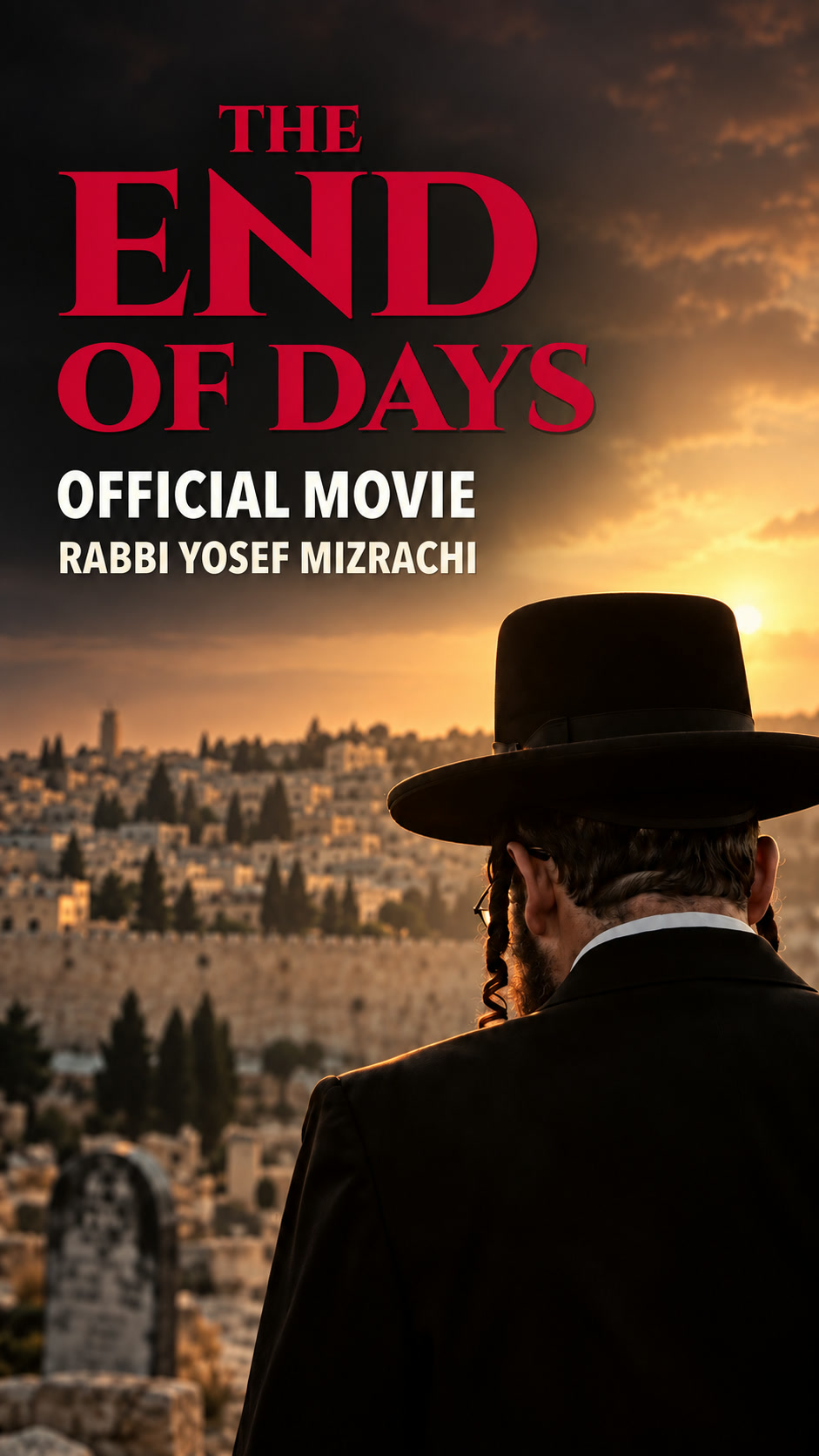
A cinematic shiur · 2026
A cinematic shiur honoring three decades of Rabbi Yosef Mizrachi’s teaching — the Jewish chronology of Creation, exile, Mashiach, resurrection, and the world that follows redemption, carried in his own voice.
Scenes from the film

Director's Commentary
Notes on the film's imagery, structure, and meaning.
Storyline
Jerusalem is not simply the setting. It is the film’s central character.
Jerusalem becomes the central character in a cinematic journey through Jewish prophecy, history, and the coming of Mashiach. Guided by Rabbi Yosef Mizrachi’s timeless teachings, recurring figures move through the city as fear gives way to Torah, teshuva, and one deeply personal question: what should we do now?
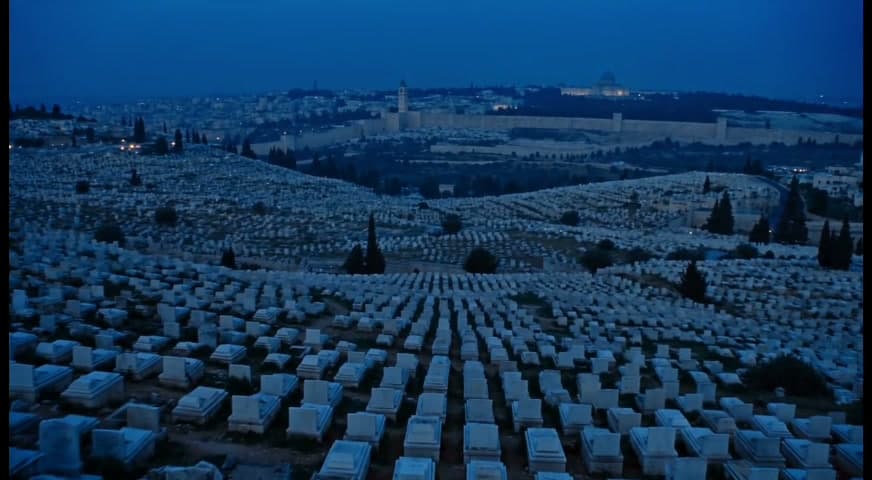
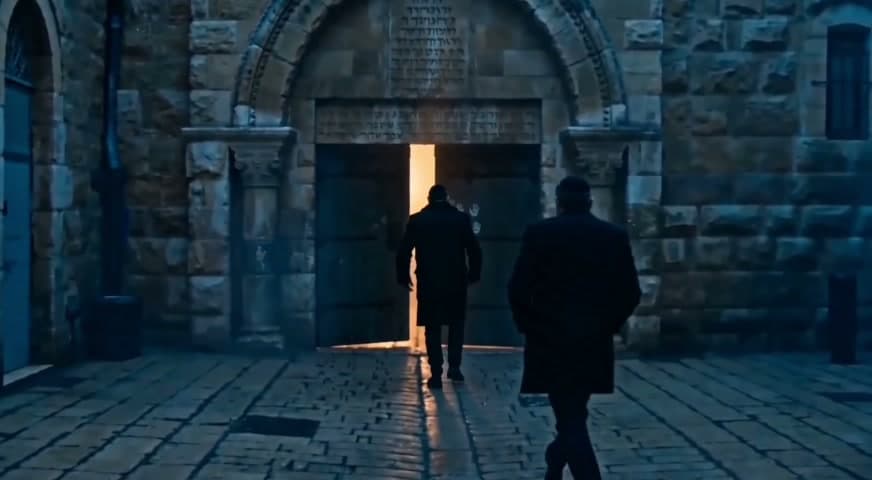
Jerusalem is the spiritual heart of Jewish history–a holy city bound to the prayers of the Jewish forefathers and to Mount Moriah, the place where the First and Second Temples stood. For generations, Jews in every part of the world have turned toward Jerusalem in prayer and carried its memory through centuries of exile. Its stones hold the history of sovereignty and destruction, pilgrimage and return, mourning and hope.
That holiness gives the film its emotional and prophetic center. Jerusalem is not treated as an ancient monument or a picturesque backdrop, but as a living place where Jewish memory meets the promise of redemption. Its gates, sacred books, families, elders, children, and worshippers connect the history of the Temples with the expectation of Mashiach and the future of the Jewish people.
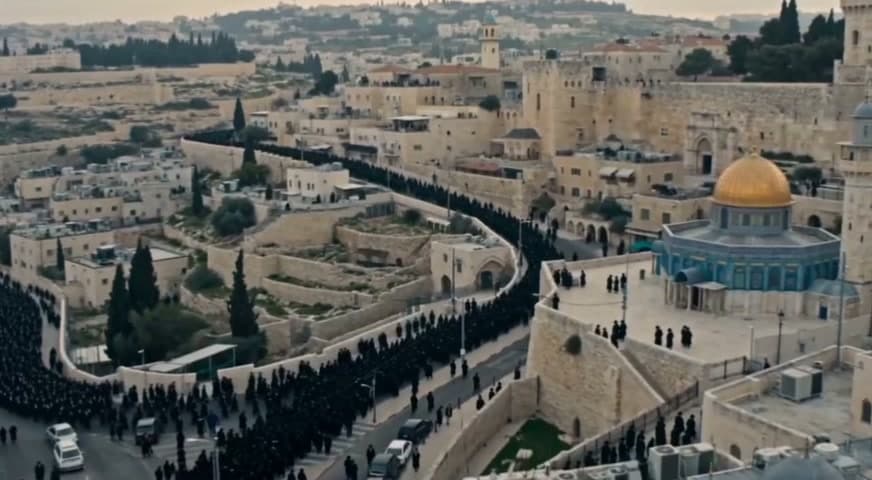
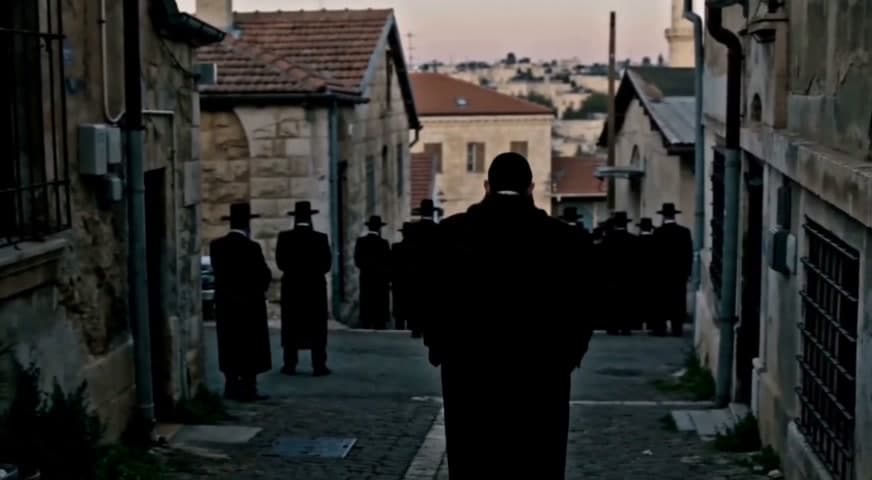
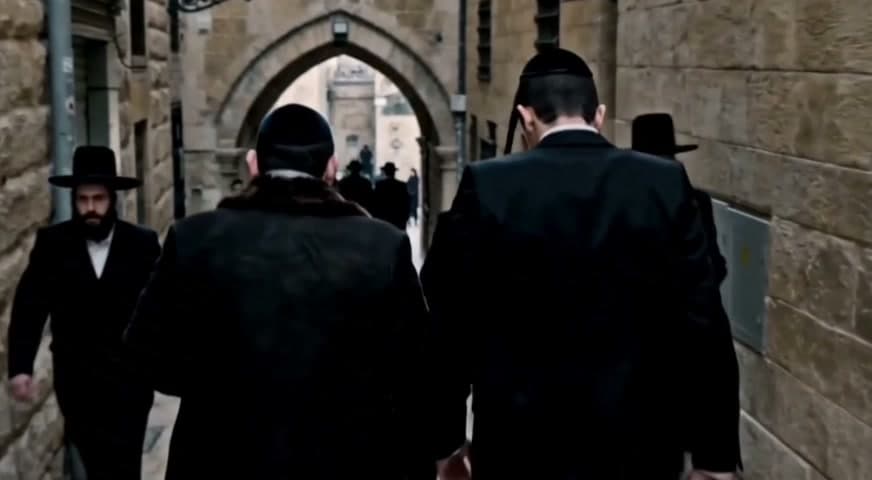
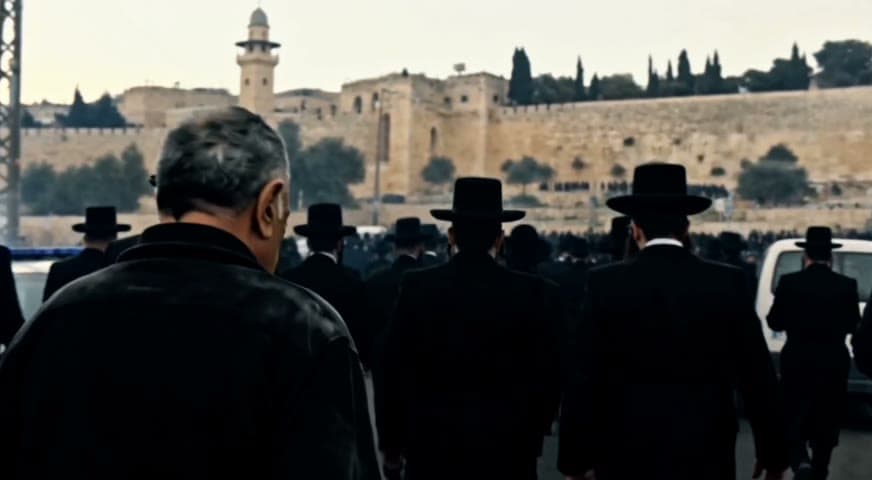
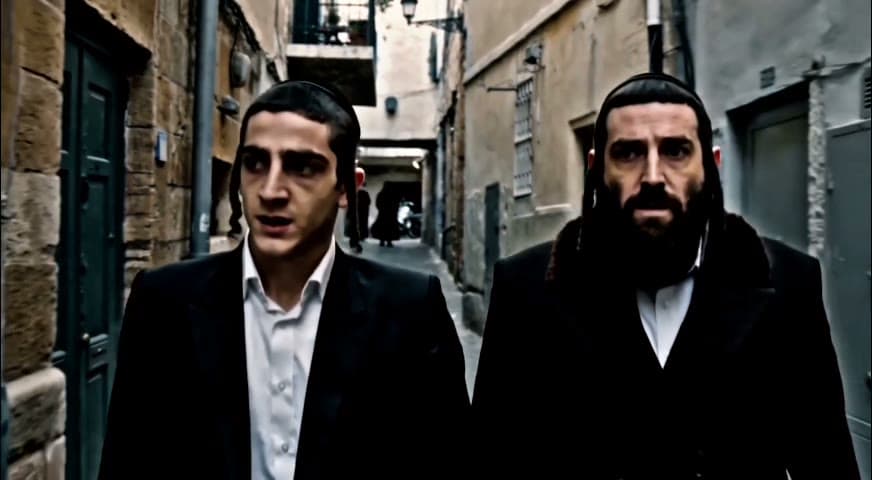
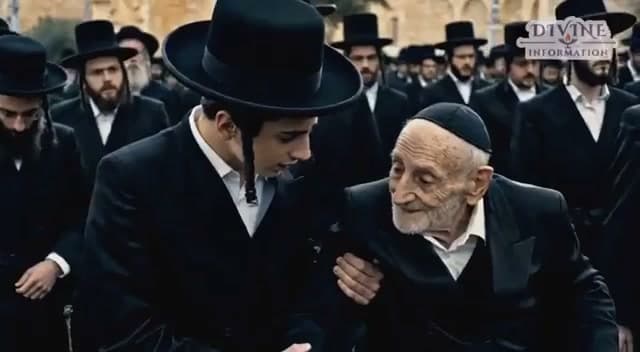
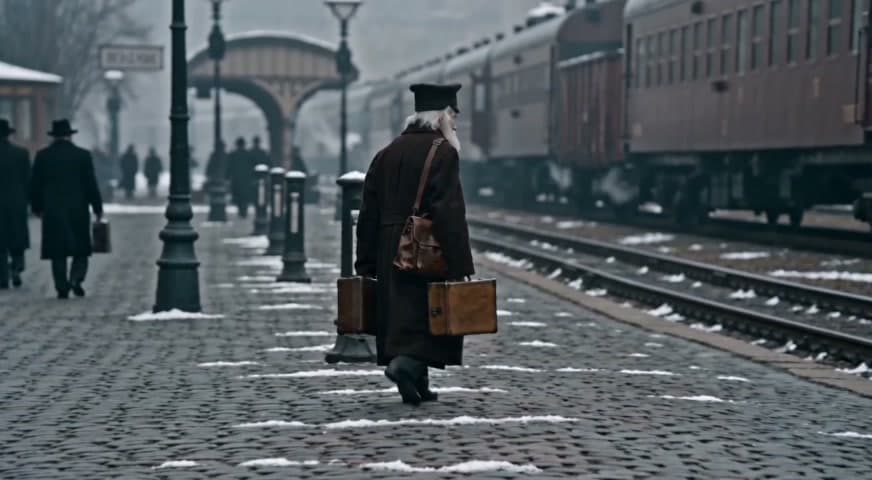
A Haredi father and son form the central human thread. Around them, a wider recurring ensemble includes another father and son, a young boy, an elderly woman, an Arab man, another elderly man, a street cat, and many other faces moving through the city. At moments, the individual figures join a vast procession flowing through Jerusalem in shared expectation of redemption. Together they create a mosaic of generations, communities, memory, and ordinary life–suggesting that the unfolding moment belongs not to one conventional protagonist, but to everyone moving through Jerusalem.
The beauty of the Haredim lies not only in the visual unity of the gathering, but in what their presence represents. Their traditional dress, prayer, families, and public Jewish identity carry the memory of generations that refused to disappear. In a film concerned with exile and redemption, they become a living answer to assimilation: Jewish life remaining recognizable, devoted, and unashamed.
That image also recalls the ancient struggle against Hellenization–the pressure to exchange Torah identity for the values and appearance of the surrounding culture. The Haredim’s movement through Jerusalem is therefore more than a crowd scene. It is a quiet act of spiritual defiance, transforming distinct individuals into a procession of continuity, faith, and expectation carried toward redemption.
The film deliberately reverses a familiar characterization. From a distance, shared dress can be misread as collectivism, conformity, or an unwillingness to think independently. Seen more closely, every person in the procession has made an individual commitment to carry a demanding and distinctive way of life. What appears uniform is composed of individual acts of conviction.
Assimilation is often presented as the path of individuality, yet the film asks whether surrendering an inherited identity to the dominant culture is truly independent. It turns the old stereotype inside out: the Haredim retain their difference, while those drawn completely into a Hellenistic way of life risk dissolving the very identity that made them distinct.
Yet the Haredim are one powerful visual symbol within a much broader ingathering, not the only people who reach redemption. The film’s teaching includes righteous Jews from every community and background, together with righteous gentiles. The Arab man who joins the procession makes that wider vision visible: what ultimately unites the gathering is righteousness and faithfulness to God, not a single culture, community, or style of dress.
“What should we do now?”
The personal question at the heart of the film
The cinematic language
Rabbi Yosef Mizrachi’s own voice carries the teaching, as he delivered it across decades of shiurim.
Recurring figures cross generations and neighborhoods, observing rather than explaining the events around them.
Gates, keys, sefarim, the Chafetz Chaim box, cars, and a helicopter mark readiness, access, urgency, and choice.
The film reaches from Creation through the arrival of Mashiach and into the world that follows–not only the events that precede redemption.
The teaching
Every stage of the chronology is drawn directly from the Torah, the Prophets, and the classical Torah authorities.
Mashiach is a future human leader descended from King David who will lead the Jewish people toward redemption, strengthen Torah observance, gather the exiles, and bring the world to peace and the knowledge of God. His coming is one of the foundational principles of Jewish faith, counted by the Rambam among the thirteen principles every Jew is obligated to believe.
Faith and accountability
Divine reward and punishment is one of the Rambam’s Thirteen Principles of Jewish faith. Jewish belief therefore carries personal accountability: our choices, actions, and the truths we accept have spiritual consequences.
The Mishnah famously begins by teaching that every Jew has a share in the World to Come. That sentence is often quoted by itself. The continuation of the Mishnah, however, identifies those who can lose that share by rejecting foundational beliefs. Treating those principles as optional is not the classical Jewish position, but a comparatively recent departure found in some circles.
At the same time, Jewish life is a journey, not merely a final destination. Rabbeinu Yonah teaches going toward the right path is itself a profound spiritual achievement no matter our level. But a journey requires knowing where it leads and by what criteria a person will be judged. Through authentic, classical Jewish sources, the film gives those questions a direct and practical answer.
A Jewish definition
The Jewish End of Days does not simply mean the destruction of the world. It refers to the culmination of history and the movement toward redemption, Mashiach, the ingathering of the Jewish people, resurrection, and the later stages leading toward the World to Come. The film explores both what precedes Mashiach and what follows his arrival.
Beyond apocalypse
The perspective is a strictly Orthodox Jewish one based on the Five Books of Moses, Prophets, Midrash, Zohar, Tannaim, Amoraim, and Geonim, including the Rambam, the Vilna Gaon, the Ramchal, Daniel, Zechariah, Ezekiel, and more–not a conventional apocalypse in which destruction is the final point. The End of Days is a transition within a much larger chronology of redemption, spiritual transformation, resurrection, and the ultimate purpose of Creation.
The complete arc
The journey does not end when Mashiach arrives. It follows a continuous framework from Creation and exile through redemption, resurrection, and the world beyond.
The film establishes the chronology of the created world and the historical framework leading toward the year 5800.
World events and upheaval are examined through the Torah sources that describe the generation preceding redemption.
Before turning to the exiles, the film briefly describes Mashiach and his role in the redemption.
The journey follows the four exiles and the place of Galut Yishmael in the final chronology.
The prophetic conflict of Gog and Magog is placed within the chronology leading toward redemption.
The Torah sources describe what unfolds when Mashiach arrives and redemption begins.
The sources teach that twenty percent of the Jewish people will make it through this stage of the chronology.
Righteous Jews and righteous gentiles are gathered as the transformation of the world continues.
The chronology moves toward a world in which idols and idolatry are destroyed.
Drawing upon the Rambam and Midrash, the film explains that Mashiach must meet defining conditions.
The destruction of Satan marks another stage in the spiritual transformation of the world.
The film expands upon the ingathering of the exiles and its place in the unfolding redemption.
The next stage addresses resurrection of the dead and its place in the larger sequence of redemption.
Drawing on the Ramchal’s Derech Hashem, the film describes four levels of holiness: the level of the prophets, the days of the Beit Hamikdash, the level attained in the days of Mashiach, and the level reached after Creation fulfills its purpose.
Stories of Rav Shach and the Chafetz Chaim bring the chronology back to lived faith, sacrifice, and the daily expectation of Mashiach.
The film asks whether a person set aside fixed time for Torah, conducted business with honesty, and awaited the arrival of Mashiach each day.
Shabbat is presented as the foundation of Jewish life and an essential expression of a person’s covenant with God.
For men, the film emphasizes setting aside time to learn Torah every day rather than allowing work and material pursuits to consume an entire life.
For women, the film emphasizes modesty as the central key through which holiness, family, and the Jewish home are protected and elevated.
The film ends in the present: a person can redirect an entire life through one sincere decision, full repentance, and the resolve to begin living faithfully now.
After redemption
Most popular End of Days treatments concentrate almost entirely on destruction and the events leading up to redemption. The End of Days goes further, examining the stages its Torah sources describe after Mashiach is revealed.
The chronology continues into the post-Mashiach world, resurrection of the dead, and the period approaching the year 7000 and beyond. In doing so, the film replaces a familiar collage of apocalyptic images with a larger question: what is the purpose and destination of history?
The future gathering is not limited to the Jewish people. The film teaches that righteous gentiles also have a place in redemption and can fulfill their purpose without converting to Judaism. Drawing upon the Rambam, it explains an essential condition every gentile should know: the Seven Noahide Laws must be kept not only because they seem logical or morally reasonable, but because they are commandments given by God. Their divine source–not human logic alone–is central to their observance.
A life’s teaching
What Rabbi Yosef Mizrachi has taught across more than thirty years stands here as a single body of work, in his own voice. Rather than treating individual signs as disconnected predictions, the film follows their relationship across the arc of Jewish history and redemption.
The original shiur carries an urgency that remains deeply relevant to the present moment. The film preserves the force of Rabbi Mizrachi’s teaching while bringing it to life in a new medium, allowing image, performance, music, and Jerusalem itself to give cinematic form to ideas first delivered across decades of Torah lectures.
The sources address the year 5800, the birth pangs of Mashiach, a brief description of Mashiach, the four exiles and Galut Yishmael, Gog and Magog, Mashiach’s arrival, the survival of twenty percent of the Jewish people, the gathering of righteous Jews and gentiles, the destruction of idolatry, the Rambam and Midrash on the defining conditions for Mashiach, the destruction of Satan, the ingathering of the exiles, resurrection of the dead, and the four levels of holiness described by the Ramchal in Derech Hashem. From there, the film turns to stories of the chachamim, the three questions asked in a person’s heavenly trial, Shabbat as the foundation of Judaism, daily Torah learning as the key for men, modesty as the key for women, and the power of one sincere decision.
The film’s purpose is not date-setting or passive speculation. Its chronology leads toward Torah, teshuva, Shabbat, modesty, faith, and a real decision in the present.
Selected stills


Innovation in kiruv
Decades of direct Torah teaching, reimagined through image, sound, character, and place.
For more than thirty years, Rabbi Mizrachi has been at the forefront of kiruv, helping revolutionize how Torah teaching reaches and moves a global audience. In 2026, that mission entered a new form with The End of Days–the first cinematic shiur of its kind and the most authoritative, comprehensively sourced film treatment of the Jewish End of Days to date.
Combining live-action filmmaking with CGI, the film gives cinematic form to a distinctly Jewish story and perspective rarely explored on screen. Its scope moves beyond familiar apocalyptic imagery to present a rare exposition of the chronology from Creation through redemption–including what Jewish sources describe after Mashiach arrives, not only the events that precede him.
Above all the film stands as a commemoration of a teaching built over a lifetime. What Rabbi Yosef Mizrachi delivered to rooms of listeners across more than thirty years is given lasting form here, to be encountered through image, sound, character, and place, and to lead viewers from prophecy and history toward teshuva and practical change.
Questions answered
Mashiach is a future human leader descended from King David who will lead the Jewish people toward redemption, strengthen Torah observance, gather the exiles, and bring the world to peace and the knowledge of God. His coming is one of the foundational principles of Jewish faith, counted by the Rambam among the thirteen principles every Jew is obligated to believe.
The Jewish End of Days does not simply mean the destruction of the world. It refers to the culmination of history and the movement toward redemption, Mashiach, the ingathering of the Jewish people, resurrection, and the later stages leading toward the World to Come. The film explores both what precedes Mashiach and what follows his arrival.
The Mishnah famously teaches that every Jew has a share in the World to Come, but its continuation also identifies those who can lose that share through the rejection of foundational beliefs. The first statement is often quoted without the second. The Rambam’s Thirteen Principles of Faith include divine reward and punishment, Mashiach, and resurrection. The film presents accountability for belief and action as the classical Jewish position, while treating the denial of foundational principles as a recent departure in some circles rather than an authentic innovation within Judaism.
The film moves beyond the signs preceding Mashiach to the chronology that follows: the revelation of Mashiach, the post-Mashiach world, resurrection of the dead, and the period approaching the year 7000 and beyond, taught by Rabbi Yosef Mizrachi directly from the Torah sources.
The perspective is a strictly Orthodox Jewish one based on the Five Books of Moses, Prophets, Midrash, Zohar, Tannaim, Amoraim, and Geonim, including the Rambam, the Vilna Gaon, the Ramchal, Daniel, Zechariah, Ezekiel, and more–not a conventional apocalypse in which destruction is the final point. The End of Days is a transition within a much larger chronology of redemption, spiritual transformation, resurrection, and the ultimate purpose of Creation.
Jerusalem stands at the heart of Jewish history, prayer, and hope. It is the holy city where the Jewish forefathers prayed, where the First and Second Temples stood, and toward which Jews have directed their prayers and longing across generations of exile. The film draws upon that living holiness: Jerusalem’s gates, streets, stones, books, and generations carry memory of destruction together with the promise of redemption, turning a vast prophetic chronology into an intimate human journey.
The Haredim embody the beauty of visible Jewish continuity. Their traditional dress, families, prayer, and movement through Jerusalem represent a people who have carried Torah identity openly across generations despite exile, persecution, assimilation, and the recurring pull of Hellenization. The film challenges the stereotype that outward similarity means collectivism or an absence of independent thought. Each figure represents an individual choice to preserve a distinct identity rather than dissolve it into the dominant culture. They are not an anonymous crowd, but many individual lives joined by memory, conviction, faith, and the refusal to disappear. Their prominence is symbolic, not exclusive: the film’s vision of redemption includes righteous Jews from every background together with righteous gentiles.
The film teaches that righteous gentiles have a place in the future redemption and do not need to convert to Judaism to fulfill their purpose. Drawing upon the Rambam, it explains that a gentile must keep the Seven Noahide Laws not only because they appear reasonable or morally logical, but because they are commandments given by God. Recognition of their divine source is the additional condition the film emphasizes and a teaching it presents as essential for every gentile to know.
The film brings together material drawn from more than ten of Rabbi Yosef Mizrachi’s lectures delivered across more than thirty years. It combines his urgent, highly relevant Torah teaching with live-action filmmaking, CGI, an original soundtrack, and symbolic recurring characters, bringing the shiur to life through a new cinematic medium.
The film draws on classical Torah sources across Rabbi Yosef Mizrachi’s lectures and decades of teaching. Together they connect Creation, exile, Mashiach, resurrection, and practical teshuva within one continuous framework.
The film’s final concern is not speculation but response. After stories of the chachamim and the three questions asked in a person’s heavenly trial, it presents Shabbat as the foundation of Judaism, daily Torah learning as the key emphasized for men, and modesty as the key emphasized for women. It ends with the teaching that one sincere decision can redirect an entire life through teshuva and faithful action beginning now.